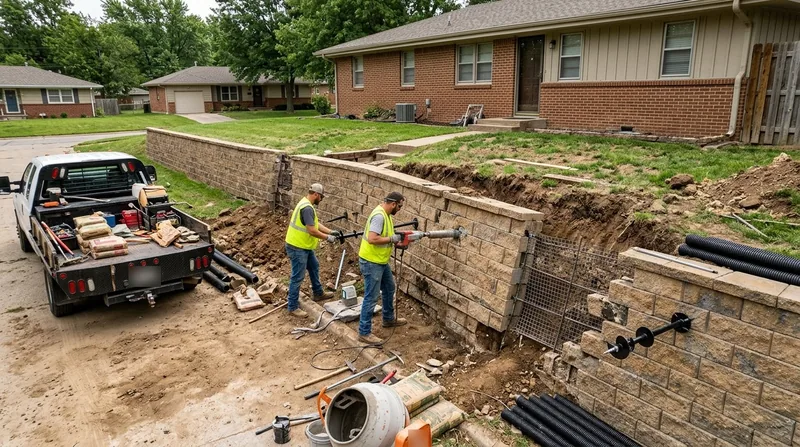




Wichita sits on the broad Arkansas River plain where the Little Arkansas joins it, and that geology writes the rules for every wall in town. Sandy river soil near the water, expansive clay on the uplands, and gentle rises toward the Flint Hills east of town mean walls move differently here than they do almost anywhere else. When the clay swells after a spring storm and shrinks in a July drought, a wall that looked fine in April starts leaning by August. That is where we come in: Retaining Wall Repair in Wichita is what we do, from drainage corrections on a 1970s split-level in Riverside to tieback anchors on a failing limestone wall in College Hill. We diagnose the cause before we touch a single block, because patching a cracked wall without fixing the water behind it is money thrown away. If your wall is past saving, we also handle retaining wall replacement so the fix is permanent, not cosmetic.
Why Retaining Wall Repair Matters More in Wichita Than Most Homeowners Realize
Most Wichita lots are flat, so the walls that fail here are not hillside walls. They are walkout basement walls in east-side subdivisions, walls along Gypsum Creek and Chisholm Creek, sunken driveway walls, and raised-bed walls that hold back heavy clay. The dominant failure mode in this city is clay movement combined with poor drainage: water saturates the backfill, the clay swells, the wall bows, and freeze-thaw swings in January and February finish the job. Catch it early and the repair is a fraction of the cost of a rebuild.
- We stop leaning and bowing walls before they collapse onto a driveway or patio.
- We correct the drainage that caused the failure, not just the visible crack.
- We repair cracked and settling walls on poured concrete, CMU, and segmental block.
- We stabilize walls along creek banks where flash flooding scours the footing.
- We rebuild failed sections on aging railroad tie and timber walls that have rotted through.
Every repair starts with finding out why the wall moved, because a wall that failed once will fail again if the cause is still there.
Key info: A wall along Chisholm Creek in west Wichita that leans after every heavy rain is almost always a drainage problem, not a block problem. We have seen homeowners pay twice for the same repair because the first contractor replaced the facing without touching the backfill.
For official guidance on when a wall needs a permit or engineered drawings, check the City of Wichita building department before you schedule work. Thresholds vary by jurisdiction and are measured from the footing.
How We Repair a Failing Wall in Wichita, Step by Step
We do not guess. A repair crew that shows up and starts slapping mortar on a crack is not repairing anything. Our process is built around diagnosing the actual cause, whether that is hydrostatic pressure from saturated clay, a footing that has settled, or a wall that was never built with proper drainage in the first place. Here is how a typical repair runs from the first call to the final walkthrough.
- We walk the wall with you and check for lean, bow, cracking, and footing movement.
- We probe the drainage behind the wall and check where water actually goes during a storm.
- We identify the failure cause: water, soil movement, root intrusion, or a footing problem.
- We give you a written repair plan with options and a firm price.
- We excavate, correct the drainage, and install tiebacks or anchors where the wall needs them.
- We rebuild failed sections and restore the wall face to match the existing material.
- We backfill with proper aggregate and restore the surface so the wall sheds water away from the house.
Most repairs are done in one to three days, and we do not leave a wall open overnight if rain is in the forecast.
Key info: A homeowner in Bel Aire had a segmental block wall bowing about 4 inches toward the driveway. We installed helical tieback anchors, replaced the drainage gravel and perforated pipe, and the wall has held straight through two springs of heavy rain. A full replacement would have cost roughly three times as much.
If the wall is already past repair, we move you to leaning and collapsed wall repair so the structure gets stabilized before anything else happens.
Repair Approaches We Use on Wichita Walls
Not every wall needs the same fix. A poured concrete wall in a 1920s College Hill bungalow has different problems than a segmental block wall in a newer Andover subdivision. We match the approach to the wall material, the soil behind it, and how far the failure has progressed. The table below shows the main approaches and when each one makes sense.
| Approach | Description | Best for |
|---|---|---|
| Drainage correction | We open the backfill, replace failed gravel and pipe, and restore proper flow away from the wall. | Walls that bow or weep after heavy rain but have no structural cracking yet. |
| Tieback anchors | We drive helical anchors into stable soil and connect them to the wall face to pull it back straight. | Leaning or bowing walls where the footing is still sound and the wall can be saved. |
| Partial rebuild | We remove and rebuild the failed section, match the existing material, and correct the base. | Localized collapse or crushing on block, CMU, or timber walls. |
| Crack injection and sealing | We inject structural epoxy or polyurethane into cracks and seal the face against water intrusion. | Poured concrete walls with hairline or moderate cracking but no movement. |
| Footing stabilization | We underpin or re-level the base where settlement has pulled the wall out of plumb. | Settling walls near creek banks and on fill soil in newer subdivisions. |
We choose the least invasive approach that actually solves the problem, because a repair that costs less and lasts longer beats a rebuild every time.
Retaining Wall Repair Cost in Wichita: What to Expect
Repairs in Wichita generally start at From $1,500 for a straightforward drainage correction or a small section rebuild, and most residential repairs land between that figure and about $6,000. A leaning wall that needs tieback anchors runs higher because of the anchor hardware and the excavation involved. Full stabilization of a collapsed wall can push past $10,000, which is why catching a problem early matters so much here. The expansive clay in this city is unforgiving, and a wall that is ignored in the fall is often a wall that has to be replaced by spring.
Several factors move the number. Wall height and length are the biggest drivers. Access matters too: a wall behind a tight fence in Riverside takes more labor than one with a clear driveway approach in Maize. The wall material changes the repair method, and a poured concrete wall with a structural crack is a different job than a segmental block wall with a bowed face. Proximity to the house, a driveway, or a utility line adds care and time. Emergency stabilization after a partial collapse costs more than a scheduled repair.
Getting two or three written estimates is smart, not because the cheapest number wins, but because it tells you whether a contractor actually diagnosed the cause or just quoted a surface patch. Ask each one what is causing the failure and how their repair addresses it. A quote that does not mention drainage on a wall in this climate is a red flag. You can see the full breakdown of typical repair ranges on our pricing page.
What to Look for When Hiring a Retaining Wall Contractor Near Me in Wichita
Hiring the right contractor matters more on a retaining wall than on almost any other home project, because a bad repair can fail silently for a year and then take the whole wall with it. Start with licensing and insurance: ask for the certificate, and confirm the coverage is current. Get at least two written estimates and compare what each one actually includes, not just the bottom line. Ask for references from jobs in Wichita or the surrounding cities and call them. Confirm who pulls the permit if your wall is above the local height threshold or supports a driveway or structure, since the City of Wichita building department sets those rules.
Check HOA requirements before work starts, especially in newer subdivisions in Andover, Maize, and Bel Aire, where architectural review may apply to visible wall repairs. If your wall is near a creek or a protected area, ask about any local restrictions before excavation begins. A contractor who hesitates on these questions is telling you something. When you are ready to talk through your wall, reach out through our contact page and we will schedule a walkthrough.
One more thing: ask how long the repair is warrantied. A contractor who stands behind the work will tell you in writing.
Retaining Wall Repair in Wichita: Pricing Guide
| Service | Price | Details |
|---|---|---|
| Drainage correction and crack repair | Starting at $1,500 | Includes excavation, new gravel and drain pipe, crack sealing, and backfill restoration on a standard residential wall. |
| Leaning wall with tieback anchors | Starting at $3,200 | Includes helical anchor installation, wall straightening, and drainage correction; price rises with wall height and anchor count. |
| Partial section rebuild | Starting at $2,400 | Includes removal of the failed section, new base preparation, and material-matched rebuild; access and material type move the price. |
| Collapsed wall stabilization and rebuild | On estimate | Needs an on-site look because footing condition, soil saturation, and utility proximity all change the scope and crew size. |
| Travel | Included | In Wichita and surrounding areas, no separate call-out or mileage fee. |
| Estimate | Free | Response within 24h at (316) 243-1027, no obligation to book. |
Indicative pricing, the exact cost depends on square footage, finish, and site access. Free personalized estimate within 24h at (316) 243-1027.


