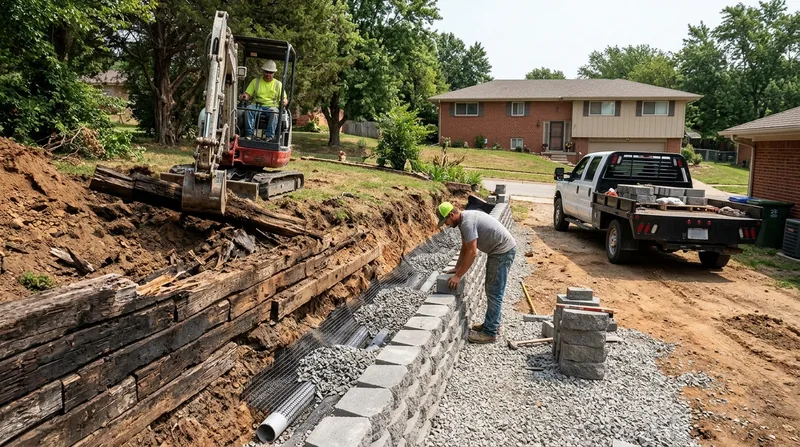




Wichita sits on the broad, flat Arkansas River plain where the Little Arkansas joins it, and most lots here are flat. That means retaining walls show up where grade changes happen: walkout basements in east-side subdivisions, creek banks along Gypsum Creek and Chisholm Creek, sunken driveways, and raised beds. The soil is the real problem. Sandy river soil near the water drains fast, but the upland clay swells after every storm and shrinks in drought, and that cycle pushes on walls year after year. If you own a 1970s, 80s, or 90s home, there is a good chance your Railroad Tie Wall Replacement in Wichita is overdue. Creosote ties have a service life of roughly 20 to 30 years, and most of the ones still standing here are past that. We remove the old ties, haul them off, fix the drainage, and rebuild in segmental block, concrete, or natural stone. If your wall is leaning or bulging, start with our leaning and collapsed wall repair page before the failure gets worse.
Why Railroad Tie Walls Are Failing Across Wichita's Clay Uplands
Creosote-treated ties were cheap and plentiful when builders put them in across Wichita in the 1970s through the 1990s. They worked for a while. Now the wood is rotting from the inside out, the creosote has leached, and the clay behind them has moved. Wichita's expansive clay swells after spring storms and shrinks hard in summer drought, and that movement racks the wall face and opens gaps. Add freeze-thaw swings in January and February and flash flooding off the flat plain, and a tie wall that looked fine five years ago can be leaning today.
- The ties rot at the soil line first, so the wall loses its structural mass from the bottom up.
- Clay backfill pushes against the wall when it swells, and the ties have no drainage to relieve it.
- Creosote leaches into planting beds and stains driveways and patios a dark brown.
- Rotted ties pull away from their deadmen and the wall starts to bulge or lean outward.
- Wood that stays wet invites termites and carpenter ants close to the house.
If you can push a screwdriver into the tie face by hand, the wall is at the end of its life and replacement is cheaper than repeated patching.
Key info: On a walkout basement lot in Bel Aire or Andover, a failing tie wall is often holding back soil right at the foundation. When that wall goes, water and clay follow. We see this most on east-side lots where the grade drops toward the basement wall.
For the official word on when a wall needs a permit in your jurisdiction, check the City of Wichita building department before you start. Thresholds vary by jurisdiction and must be verified locally.
How We Replace a Railroad Tie Wall in Wichita, Step by Step
We do not pull ties and drop new block in the same hole. A tie wall that failed did so because of water and clay pressure, and a new wall built the same way will fail the same way. Our process starts with the soil and drainage behind the wall, not the wall face. Every job gets a site walk first so we can see the grade, the soil, and where the water actually goes.
- We walk the site and check the soil, the grade, and where water drains before we quote the job.
- We excavate to stable soil and shape the base trench to the correct depth and batter.
- We compact a gravel base, then set and level the first course of block, concrete, or stone.
- We install gravel backfill and a perforated drain pipe behind the wall, wrapped in filter fabric.
- We build the wall up in lifts, compacting backfill as we go, and cap it with a finished top course.
- We clean the site and walk the finished wall with you before we pack up.
Every replacement gets drainage designed for the wall, because that is what keeps the new wall standing through a Kansas storm season.
Key info: On a recent job near Chisholm Creek, the old ties were sitting on bare clay with no gravel and no drain pipe. We pulled 14 courses of rotted tie, cut the bank back to stable soil, and rebuilt in segmental block with a full gravel chimney and drain to daylight. That wall will handle the clay movement that killed the old one.
If your tie wall is still holding but the drainage is suspect, our retaining wall drainage service can fix the water problem before the wall fails.
Replacement Options: What We Build Instead of Ties
Once the old ties are out, you have real choices, and the right one depends on wall height, load, and how the wall looks against your house. A 1970s split-level in College Hill and a newer brick home in Maize do not call for the same wall. We walk you through the options based on your grade, your soil, and your budget.
| Approach | Description | Best for |
|---|---|---|
| Segmental block | Interlocking concrete block with gravel backfill and drain pipe, engineered for clay soils. | Most residential replacements, walls up to 4 to 6 feet. |
| Poured concrete | Cast-in-place reinforced wall with a formed face, built for heavy lateral loads. | Tall walls, driveway surcharge, structural basement walls. |
| Natural stone | Flint Hills limestone or boulder wall laid dry or mortared, with drainage behind. | Visible garden walls and homes that want a natural look. |
| New timber wall | Pressure-treated landscape timber with proper deadmen and gravel backfill. | Low garden walls where budget is the priority. |
| Tie removal only | Demolition and haul-away of the old creosote ties, with site grading. | Homeowners rebuilding later or regrading the slope. |
We match the material to the load and the look, and we tell you when a cheaper option will not hold on your soil.
Railroad Tie Wall Replacement Cost in Wichita: What to Expect
Railroad tie wall replacement in Wichita starts from $35 per square foot of wall face for a standard segmental block rebuild with new gravel backfill and drainage. That figure moves with wall height, access, and material. A low garden wall along a driveway in Haysville prices very differently from a tall basement wall in Andover where we cannot get a machine to the back side. Creosote tie disposal also adds cost, because the old wood has to go to a licensed facility, not the curb.
Factors that move the number:
- Wall height and length drive the square footage, and height over 4 feet adds engineering and permit cost.
- Access matters. A wall you can reach with a skid steer is cheaper than one we have to dig by hand behind a fence.
- Material choice swings the price, from treated timber at the low end to natural Flint Hills stone at the top.
- Soil and drainage conditions add work when the clay is wet or the old wall has no drain.
- Disposal of creosote-treated ties is a real line item and varies with volume.
Get two or three written estimates and compare scope, not just the total. A low bid that skips the drain pipe is not a bargain. Our pricing page breaks down the full range.
Railroad Tie Wall Replacement Near Me: How to Hire in the Wichita Area
Anyone with a truck can pull ties. Hiring a contractor who builds a wall that lasts takes a little checking, and it is worth the hour. Ask for the license and insurance certificate, and confirm the coverage is current. Get at least three written estimates with the same scope so you can compare them. Ask for local references on tie replacements, not just new installs, and call them. Check whether your HOA has rules on wall material or color, and confirm permit requirements with the local building department before work starts.
A contractor who will not put the drainage scope in writing is telling you something. Walk away.
Ready to get a number on your wall? Reach out through our contact page and we will set up a site visit.
Railroad Tie Wall Replacement in Wichita: Pricing Guide
| Service | Price | Details |
|---|---|---|
| Segmental block replacement | Starting at $35/sq ft | Includes tie removal, gravel base, block, drain pipe, and haul-away for standard access walls. |
| Concrete wall replacement | Starting at $55/sq ft | Reinforced poured wall for tall or surcharge loads, priced by height and forming access. |
| Natural stone replacement | Starting at $65/sq ft | Flint Hills limestone or boulder face with drainage, priced by stone type and wall batter. |
| Tie removal and haul-away only | Starting at $12/sq ft | Demolition, creosote tie disposal at a licensed facility, and rough site grading included. |
| Complex or large-scale job | On estimate | Tall walls, tight access, engineered designs, and tiered walls need an on-site look first. |
| Estimate | Free | Site visit and written scope within 24 hours at (316) 243-1027, no obligation. |
Indicative pricing, the exact cost depends on square footage, finish, and site access. Free personalized estimate within 24h at (316) 243-1027.


