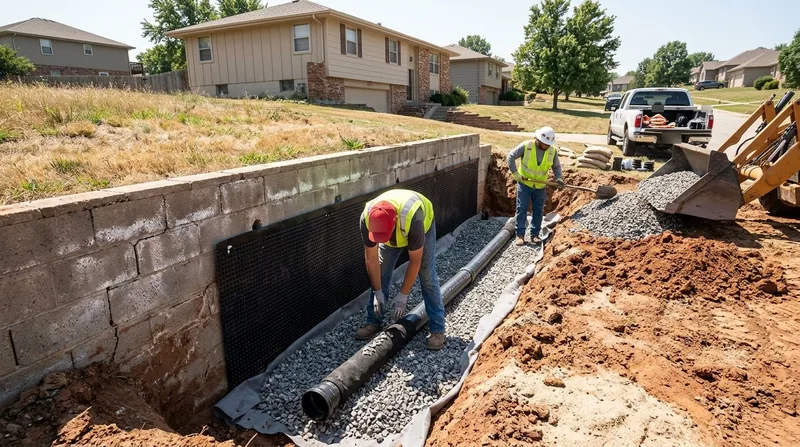




Wichita sits on the broad, flat Arkansas River plain where the Little Arkansas joins it, and that geography drives nearly every retaining wall failure we see. Sandy river soil near the water drains fast, but the expansive clay on the uplands swells after every storm and shrinks hard in drought. Add flash flooding, freeze-thaw swings and hard Kansas sun, and water becomes the number one enemy of any wall. Retaining Wall Drainage in Wichita is the work that keeps hydrostatic pressure from pushing your wall over, and it is the cheapest insurance you can buy against a leaning or collapsed wall. Whether you have a walkout basement wall in an east-side subdivision, a creek-bank wall along Gypsum Creek or Chisholm Creek, or an aging railroad tie wall holding a raised bed in College Hill, we build drainage systems that move water away before it does damage. Call (316) 243-1027 for a free estimate, and read our retaining wall repair page if your wall is already showing movement.
Why Drainage Decides Whether a Wichita Wall Stands or Falls
Most walls we tear out in Wichita did not fail because the block was weak or the stone was bad. They failed because water stacked up behind them with nowhere to go. Expansive clay holds moisture against the wall for days after a storm, and when that saturated soil freezes and thaws through a Kansas winter, the pressure multiplies. A wall with no weep holes, no gravel backfill and no drain pipe is a dam waiting for the right storm.
- Hydrostatic pressure from saturated clay pushes walls outward and causes the lean we repair most often.
- Poor drainage erodes the footing soil and lets walls settle unevenly.
- Water trapped behind a wall softens mortar joints and speeds up freeze-thaw damage.
- Clogged or missing weep holes turn a small drainage problem into a structural one.
- Drainage fixes cost far less than replacing a failed wall later.
If your wall already leans, bulges or has separated joints, drainage work alone will not save it. Call us for a leaning wall assessment before the next storm season.
Key info: A segmental block wall along a creek bank in Derby can look perfect on the surface and still be full of water after a spring storm. We have pulled walls in Haysville and Park City where the only real problem was a missing drain pipe and clogged weep holes.
For official guidance on walls and grading, check the City of Wichita building department resources before you start a project.
How We Build Drainage That Actually Works in Wichita Soil
We do not guess at drainage. We look at the wall, the soil behind it, the slope above it and where the water goes when it leaves the site. Then we build a system that handles the water volume Wichita actually gets, not a token weep hole every eight feet. Every job starts with an on-site look, and every system we install is sized to the wall and the lot.
- We inspect the wall, footing and surrounding grade to find where water is entering and where it is trapped.
- We clear clogged weep holes and add new ones where the wall is missing them.
- We install gravel backfill wrapped in filter fabric so clay cannot plug the drainage zone.
- We run a perforated French drain pipe along the footing and daylight it to a safe discharge point.
- We waterproof the wall face where the wall is concrete or CMU and backfill in compacted lifts.
- We restore the grade so surface water runs away from the wall instead of into it.
Done right, this work protects the wall for decades and costs a fraction of what a replacement runs.
Key info: On a walkout basement wall in an Andover subdivision, we found the original builder had backfilled with straight clay and no drain pipe. We cut in a French drain, added gravel and fabric, and opened new weep holes. The wall stopped moving and the homeowner avoided a full replacement.
If your wall is a timber or railroad tie structure, drainage is even more critical because the wood rots faster when it stays wet. See our railroad tie wall replacement page for options.
Drainage Approaches We Use
Not every wall needs the same system. A low garden wall in Maize may only need weep holes and gravel, while a tall wall holding a driveway in Bel Aire needs a full French drain and waterproofing. Here is how the main approaches compare.
| Approach | Description | Best for |
|---|---|---|
| Weep holes and gravel backfill | We open or add weep holes and pack a gravel and fabric drainage zone behind the wall. | Low garden walls and raised beds |
| French drain along the footing | We install perforated pipe in gravel, wrapped in fabric, and daylight it to a safe outlet. | Tall walls and walls on clay uplands |
| Waterproofing and membrane | We coat or membrane the wall face to keep water out of concrete and CMU. | Poured concrete and basement walls |
| Surface grading and swales | We reshape the grade so runoff moves away from the wall and the lot drains. | Flat lots and creek-bank properties |
| Full drainage rebuild | We remove failed backfill, rebuild the drainage zone and reset the wall where needed. | Leaning walls and saturated sites |
We pick the approach that fits your wall and your budget, not the one that is easiest to sell.
Retaining Wall Drainage Cost in Wichita: What to Expect
Drainage work starts at From $2,500 for a typical residential wall, and that figure covers the basics: weep holes, gravel backfill, filter fabric and a drain pipe run to a safe outlet. The final number depends on wall length and height, how much soil we have to move, how deep the footing sits, access for equipment and whether the wall needs waterproofing or partial rebuild. A wall on a tight lot in College Hill costs more to work on than an open lot in Maize, and a saturated clay site takes more excavation than sandy river soil.
Getting two or three estimates is smart because drainage problems are easy to misdiagnose. A contractor who quotes a full replacement when a drain pipe and gravel would fix the problem is not doing you a favor. Ask each contractor to explain what is causing the water problem and what the fix actually does. For a fuller breakdown of what we charge, see our pricing page.
Retaining Wall Drainage Near Me: How to Hire in the Wichita Area
When you search for retaining wall drainage near me, you will get a long list of names, and not all of them are set up to do the work right. Drainage is invisible once it is buried, so the contractor you hire matters more than the price on the estimate. Use these checks before you sign anything.
- Confirm the contractor is fully insured, and ask for a certificate of insurance before work starts.
- Get at least two or three written estimates that explain the cause of the problem and the fix.
- Ask for local references from walls similar to yours, and call them.
- Check whether your project needs a permit from the local building department, especially for walls above roughly 4 feet or walls that support a driveway or structure.
- Ask about HOA rules and property-line setbacks before excavation begins.
If a contractor cannot explain how water moves on your lot, keep looking. Ready to get a straight answer on your wall? Reach out through our contact page and we will set up a free on-site estimate.
Retaining Wall Drainage in Wichita: Pricing Guide
| Service | Price | Details |
|---|---|---|
| Basic drainage retrofit | Starting at $2,500 | Includes weep holes, gravel backfill, filter fabric and a drain pipe run to a safe outlet. |
| Full French drain system | Starting at $4,200 | Adds a perforated footing drain, deeper excavation and waterproofing on concrete or CMU walls. |
| Drainage plus partial wall rebuild | On estimate | Needed when the wall has moved and the backfill must be removed and reset before drainage goes in. |
| Travel | Included | In Wichita and surrounding areas, no separate call-out or mileage fee. |
| Estimate | Free | Response within 24h at (316) 243-1027, no obligation to book. |
Indicative pricing, the exact cost depends on square footage, finish, and site access. Free personalized estimate within 24h at (316) 243-1027.


